Artificial Intelligence, or AI, has become a big part of our daily lives. We use AI when we search for information, write content, edit photos, watch videos, shop online, use voice assistants, or communicate with businesses.
A few years ago, AI seemed like something from the future. Today, it is already being used by students, businesses, developers, marketers, teachers, and almost every type of industry.
But AI is changing very quickly.
In 2026, AI is moving beyond simple chatbots and content-writing tools. AI is becoming smarter, faster, and more useful. It can understand text, images, audio, video, and documents. It can also help people complete tasks instead of only answering questions.
For businesses and individuals, understanding the latest AI trends in 2026 can help you prepare for the future. You do not need to be a technology expert to understand these trends. In this article, we will explain the most important AI trends in simple language.
1. AI Agents Are Becoming More Popular
One of the biggest AI trends in 2026 is the growth of AI agents. You may already know AI tools that answer questions or write content. AI agents take this idea one step further. A normal AI tool waits for your instructions and gives you an answer. An AI agent can take a goal and complete several steps to achieve it.
For example, imagine you ask an AI agent:
“Find the best keywords for my website and prepare a report.”
Instead of only giving you keyword ideas, an AI agent could research the topic, organize the keywords, analyze them, and prepare a report.
AI agents can be useful for many business tasks, including:
- Customer service
- Marketing
- Research
- Data analysis
- Sales
- Software development
- Email management
- Report preparation
This does not mean that humans will disappear. Instead, AI agents can help people save time by handling repetitive tasks.
2. AI Will Do More Work for People
In the past, people mainly used AI as an assistant.
For example, you could ask AI to write an email, create a blog idea, summarize a document, or explain a topic.
Now, AI is slowly moving toward doing complete tasks. This is an important change.
Instead of saying:
“Help me create a report.”
You may be able to say:
“Create this month’s marketing report.”
AI can then collect information, organize it, analyze it, and prepare the report. Of course, people will still need to check important work. But this change can save a lot of time. Businesses are especially interested in this because employees spend many hours doing repetitive work. AI can handle some of those tasks while employees focus on more important work.
3. AI Can Understand More Than Just Text
Another important AI trend in 2026 is multimodal AI. Don’t worry about the technical name. It simply means that AI can understand different types of information.
For example, AI can work with:
- Text
- Images
- Audio
- Video
- Documents
- Charts
- Code
In the past, you might have needed different tools for each type of information. Now, one AI system can increasingly work with several types of content.
For example, you could upload an image and ask AI to explain it. You could upload a PDF and ask AI to summarize it. You could provide a video and ask AI to identify important points. You could give AI an image of a website problem and ask for help fixing it. This makes AI much more useful for everyday work.
4. AI Is Getting Better at Solving Difficult Problems
AI is also becoming better at handling complicated questions. Earlier AI tools were mainly good at generating text and answering simple questions. Modern AI systems are increasingly designed to spend more effort solving difficult problems.
This can be useful for:
- Mathematics
- Programming
- Research
- Business analysis
- Planning
- Data analysis
- Technical problems
For example, a developer can give AI a complicated coding problem and ask it to find the cause of an error. AI may analyze the code, identify the problem, suggest a solution, and explain why the solution works. However, AI can still make mistakes. That is why human checking is still important, especially when the information is related to money, business, law, security, or other important decisions.
5. Smaller AI Models Will Become More Useful
When people talk about AI, they often think about very large AI models. But another important trend is the growth of smaller AI models. Not every task requires a very powerful AI system. For example, if a company only wants AI to organize customer messages, a smaller model may be enough.
Smaller AI models can offer several advantages:
- They can be faster.
- They can cost less.
- They may require fewer resources.
- They can be designed for specific tasks.
- Businesses can have more control over them.
This means the future of AI may not be about using one huge AI model for everything. Instead, companies may use different AI models for different jobs. For example, one model could handle customer support while another handles data analysis and another helps developers write code.
6. AI and Automation Will Work Together
Automation is not new. Businesses have been using automation for years to send emails, process orders, manage data, and perform other repetitive tasks. AI is making automation more powerful. Traditional automation usually follows fixed instructions.
For example:
“If a customer fills out this form, send them an email.”
AI-based automation can understand more complicated information.
For example, if a customer sends a message, AI can understand the message, identify the customer’s problem, find useful information, and prepare a response. This can help businesses save time.
AI automation can be used in:
- Customer support
- Email marketing
- Sales
- Accounting
- Data entry
- Social media
- Website management
- Online stores
The goal is not simply to automate everything. The goal is to automate repetitive work while allowing people to focus on tasks that require human thinking.
7. AI Will Change Software Development
Software developers are already using AI in their daily work.
AI can help developers:
- Write code
- Find coding errors
- Explain code
- Create tests
- Write documentation
- Build simple applications
- Solve technical problems
In 2026, It is becoming more involved in the development process.
For example, instead of asking AI to write only one small piece of code, a developer may ask AI to help solve a larger problem across a project. AI can review code, suggest changes, and help find bugs. However, developers are still very important. AI-generated code needs to be checked. A developer must make sure that the code is secure, works correctly, and fits the project. So It is not simply replacing developers. It is becoming another tool that developers can use to work faster.
8. AI Security Will Become More Important
As AI becomes more powerful, security becomes a bigger concern. Businesses are using AI with important information, including customer data, company documents, financial information, and internal systems. This creates new risks.
For example, companies need to make sure that AI does not accidentally share private information. They also need to control what an AI system is allowed to do. If an AI agent can access company software, it should not automatically have permission to perform every action. Businesses therefore need proper security rules.
They should decide:
- What information can AI access?
- What tasks can it perform?
- Who can use the AI system?
- When should a human approve an action?
- How should AI activity be monitored?
As AI becomes more common, AI security will become an important part of every business’s technology strategy.
9. Responsible AI Will Become More Important
AI can do many useful things, but it also creates important questions.
For example:
Can AI-generated information be trusted?
Who is responsible if AI makes a serious mistake?
How should personal information be protected?
Can AI-generated images or videos be used without permission?
These questions are becoming more important as AI becomes part of everyday life.
Governments and organizations around the world are working on rules and guidelines for AI.
Businesses therefore need to think about responsible AI use.
Using AI responsibly means:
- Checking important information
- Protecting private data
- Following laws and regulations
- Being honest about AI-generated content
- Keeping humans involved in important decisions
- Monitoring AI systems
AI should be powerful, but it should also be used carefully.
10. AI Skills Will Become Important for Almost Every Job
You do not have to become an AI programmer to benefit from AI. This is one of the most important things to understand. AI skills will become useful in many different careers.
For example, a marketer can use AI to research keywords and create content ideas. A designer can use AI to generate creative concepts. A teacher can use AI to prepare learning materials. A business owner can use AI to analyze customer information. A developer can use AI to write and test code. A student can use AI as a learning assistant. Because of this, basic AI knowledge will become increasingly valuable.
You should learn how to:
- Ask AI clear questions
- Check AI answers
- Use AI tools for your work
- Protect private information
- Understand the limitations of AI
- Combine AI with your existing skills
The most valuable person may not be someone who knows everything about AI. It may be someone who knows how to use AI to solve real problems.
11. AI Will Become More Personal
AI is also becoming more personalized. Instead of giving every person the same experience, AI systems can provide answers based on individual needs and preferences.
For example, a learning platform could understand a student’s current level and suggest lessons that match their knowledge. An online store could recommend products based on previous shopping behavior. A business AI assistant could understand a company’s workflow and provide more useful suggestions. Personalized AI can make technology easier and more helpful.
But there is an important issue: privacy. If AI knows more about users, companies need to protect that information carefully.
12. AI Will Become Part of Physical Machines
AI is not going to stay only inside computers and phones. Another interesting AI trend in 2026 is the growth of AI-powered physical machines. This includes robots, smart machines, industrial equipment, and other devices that can understand their surroundings and make decisions.
For example, AI-powered robots can be used in warehouses and factories. AI can help machines recognize objects, understand their environment, and perform specific tasks. We are still far from having highly intelligent robots everywhere, but the technology is moving forward.
In the future, AI could become an important part of transportation, manufacturing, healthcare equipment, agriculture, and many other industries.
13. AI Search Will Change How People Find Information
Search engines are also changing because of AI. In the past, people usually searched by typing a few keywords.
For example:
“Best trekking destinations Nepal”
Now people can ask longer questions such as:
“What is the best trekking destination in Nepal for a beginner with one week?”
AI can understand the question and provide a more direct answer. This is also changing SEO. Businesses can no longer focus only on adding keywords to a webpage. They need to create useful, clear, and trustworthy content. Good content should answer real questions and provide value to readers. For website owners and digital marketers, understanding AI search will therefore become increasingly important.
14. AI Will Help Businesses Save Time and Money
One of the biggest reasons businesses are interested in AI is simple: AI can save time. Think about a business where employees spend hours every week creating reports, answering common questions, organizing information, or entering data. AI can help automate some of this work. When repetitive tasks become faster, employees can spend more time on important activities. For small businesses, this can be especially useful. A small company may not have enough employees to handle every task manually.
AI can help with:
- Customer communication
- Content creation
- Marketing
- Research
- Data organization
- Business reports
- Scheduling
- Website content
However, businesses should not use AI simply because everyone else is using it. They should first identify a real problem and then see whether AI can provide a useful solution.
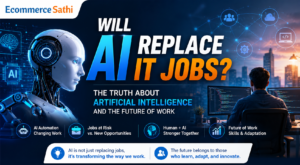
15. AI Will Not Replace Every Human Job
Whenever people talk about AI, one common question appears:
“Will AI take our jobs?”
The answer is more complicated than yes or no. AI will probably change many jobs. Some repetitive tasks may become automated. Some jobs may require fewer manual tasks. At the same time, new jobs and new responsibilities can appear. For example, businesses may need people who can manage AI systems, check AI results, create AI workflows, protect AI systems, and train employees to use AI. The bigger change may therefore be that jobs will change rather than simply disappear. People who learn how to work with AI may have an advantage over people who completely ignore it.
How Can You Prepare for the Future of AI?
You do not need to learn everything about AI at once.
Start small.
Choose AI tools that are useful for your work or studies.
For example, if you are a content writer, learn AI writing and research tools.
If you are a developer, learn AI coding tools.
If you are a marketer, learn AI tools for SEO, advertising, research, and content.
If you are a student, learn how to use AI for research and learning without depending on it for everything.
Most importantly, do not stop developing your human skills.
Skills such as communication, creativity, critical thinking, problem-solving, and decision-making will remain valuable.
AI can give you information and suggestions.
You still need to decide what is right.
The future of AI in 2026 is not only about chatbots or generating content. AI is becoming part of everyday work.
AI agents are becoming more useful. AI can understand different types of information. AI is improving at solving difficult problems. Businesses are using AI for automation, customer service, marketing, software development, and data analysis.
At the same time, AI security, privacy, responsible use, and human oversight are becoming more important. The most important lesson is simple: you do not need to be afraid of AI, but you should learn how to use it. AI is becoming another important digital skill. People who understand how to use AI effectively can save time, improve their work, and discover new opportunities. Whether you are a student, business owner, employee, marketer, designer, developer, or content creator, now is a good time to start learning about AI. The AI revolution is not something that will happen only in the future. It is already happening, and 2026 is another important step in that journey.